

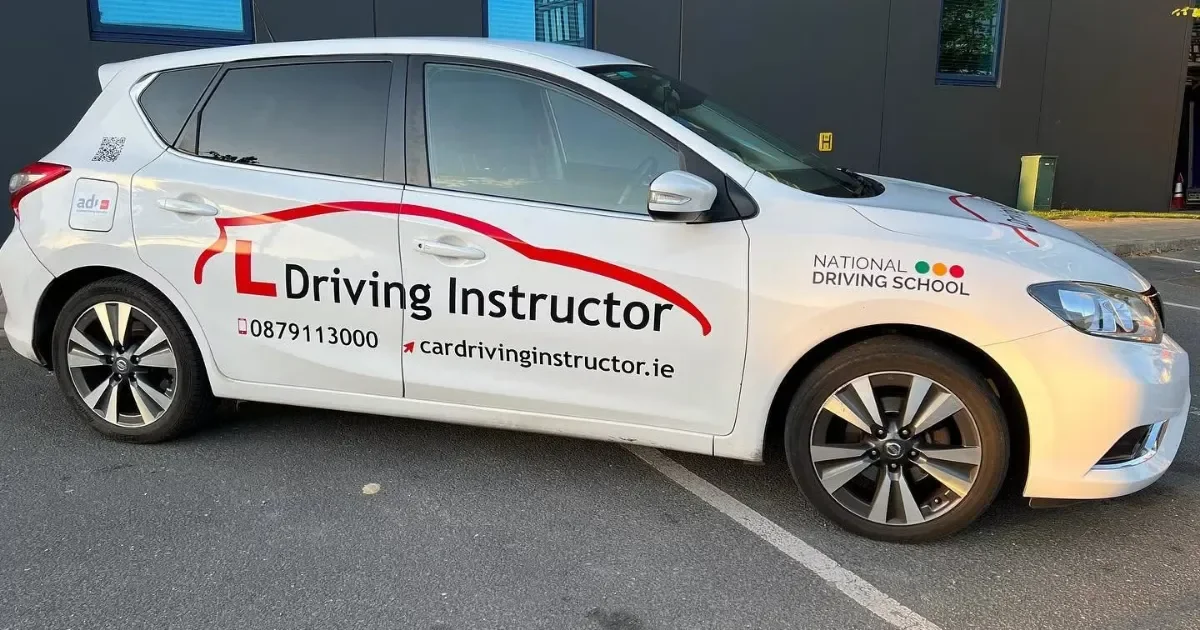
You've completed your driving lessons, received your driving test date and now the big day is approaching. It's completely normal to feel nervous, especially if you're not sure exactly what happens during the test. The good news is that knowing what to expect can help you feel more prepared and allow you to concentrate on your driving. From arriving at the test centre and answering theory questions to completing your manoeuvres and receiving your results, here's what you need to know about the Irish driving test.
1. Arriving at the Driving Test Centre
The first thing to do is make sure you arrive at the correct test centre with plenty of time to spare.
The RSA recommends being inside the test centre at least 10 minutes before your scheduled appointment.
Remember, you must still be accompanied by a qualified accompanying driver when travelling to your test centre.
Before leaving home, check that you have:
Your valid learner permit.
A valid certificate of motor insurance covering you to drive the test vehicle.
Any additional insurance confirmation required if you're not named on the certificate.
A suitable, roadworthy vehicle with the required tax, insurance and NCT documentation, where applicable.
L-plates clearly displayed on the front and rear of the vehicle.
Important: Since 9 March 2026, driving test candidates have been required to present a valid motor insurance certificate as proof that they're insured to drive the test vehicle. Bring a printed certificate and check the latest RSA instructions for accepted documents.
When you arrive, go into the waiting area rather than remaining in your car.
Your examiner will call you when it's time to begin.
2. Meeting Your Driving Test Examiner
Your examiner will introduce themselves and begin by checking your learner permit and the required documentation.
They'll also explain the next stages of the test.
It's worth remembering that the examiner isn't there to catch you out. Their job is to assess whether you can drive safely and independently.
Unlike a driving instructor, the examiner won't provide coaching or advice while you're driving.
They'll give you directions, but it's up to you to demonstrate the appropriate observations, positioning, vehicle control and decision-making.
3. Theory Questions and Rules of the Road
Before getting behind the wheel, you'll be asked questions about the Rules of the Road and road safety.
These are designed to assess your knowledge of important driving rules and your understanding of safe driving practices.
You may be asked about:
Speed limits on different types of roads.
Right-of-way rules at junctions.
Safe following distances.
Road markings and traffic signs.
Responding to pedestrians and cyclists.
Driving in different weather and road conditions.
Road safety and vehicle awareness.
The examiner may also ask you to identify road signs and demonstrate hand signals.
Remember: This isn't another full Driver Theory Test, but you should revise the Rules of the Road beforehand.
If you'd like to practise, our Driving Test Questions and Road Signs resources can help.
4. Vehicle Safety and Under-the-Bonnet Checks
The next stage involves demonstrating your knowledge of basic vehicle safety.
The examiner may ask you to identify or explain how you would carry out checks such as:
Checking the engine oil level.
Checking engine coolant.
Inspecting tyre condition.
Checking the windscreen washer fluid.
Identifying dashboard warning lights.
Checking vehicle lights and indicators.
You may also be asked to operate secondary controls, such as the windscreen wipers, demisters and lights.
You don't need to know everything about how a car works, but you should understand the basic checks needed to keep it safe.
Our Under the Bonnet Guide is a useful resource to revise before your test.
5. Starting the Practical Driving Test
Once the initial questions and checks are complete, you'll begin the practical driving section.
The examiner will sit in the front passenger seat and provide directions.
During the drive, you'll be assessed on how you handle everyday driving situations, including:
Approaching and negotiating junctions.
Roundabouts and lane positioning.
Driving through residential areas.
Responding to road signs and markings.
Using mirrors and signals correctly.
Managing your speed and making appropriate progress.
Observing other road users.
Maintaining proper control of the vehicle.
The RSA states that the practical driving route covers approximately 8km through a variety of road and traffic conditions.
You won't know the exact route in advance, so it's important to focus on safe driving rather than trying to memorise particular roads.
6. Turnabouts, Reversing Around a Corner and Hill Starts
As part of the practical driving test, you'll need to demonstrate your ability to carry out important manoeuvres.
These are skills you've likely spent time practising during your driving lessons.
Turnabout (Three-Point Turn)
The examiner will ask you to turn your car around on the road so that you're facing the opposite direction.
While it's commonly called a three-point turn, completing the manoeuvre safely is more important than completing it in exactly three movements.
Pay particular attention to observation, vehicle control, approaching traffic and other road users.
Reversing Around a Corner
You'll be directed to reverse around a suitable corner into a side road.
The examiner will assess your control of the vehicle, road positioning and observations throughout the manoeuvre.
Remember to keep your speed slow, check your surroundings carefully and stop if it becomes unsafe to continue.
Hill Starts
You'll also need to demonstrate that you can move away safely when stopped on an incline.
For manual drivers, this involves coordinating the clutch, accelerator and brakes to avoid excessive rollback.
For automatic drivers, vehicle control and observation remain equally important.
Practising these manoeuvres before test day can help you feel much more comfortable when the examiner asks you to complete them.
7. What Happens if You Make a Mistake?
One of the biggest concerns learners have is making a mistake during their driving test.
It's important to remember that not every mistake automatically means you've failed.
The examiner assesses faults according to their nature and seriousness.
If you make a small mistake, try not to let it affect the rest of your driving.
For example, if you stall the car, concentrate on securing the vehicle, carrying out the appropriate observations and moving away safely when it's appropriate.
There's no benefit in spending the next few minutes worrying about something that has already happened.
Instead, keep your attention on the road and continue driving safely.
8. Returning to the Test Centre and Getting Your Results
Once the practical driving section is complete, the examiner will direct you back to the test centre.
After the test, you'll be informed of your result and receive feedback on your driving.
If You Pass Your Driving Test
Congratulations! You'll receive a Certificate of Competency, which allows you to apply for your full driving licence.
However, passing your test doesn't mean you can immediately drive unaccompanied.
You must continue following learner permit rules until you've received your full driving licence.
If You Don't Pass
While it can be disappointing, an unsuccessful result provides useful feedback on the areas you need to improve.
You'll receive a statement of your driving test outcome, which you can review with your driving instructor.
Understanding your marking sheet can help you focus on the areas that need additional practice before your next attempt.
You can read more in our Driving Test Marking Sheet Guide.
9. Should You Book a Pre-Test Driving Lesson?
If your test is approaching and you're unsure whether you're fully prepared, a pre-test lesson can be worthwhile.
A pre-test allows your instructor to assess your current driving standard and identify areas that might benefit from additional practice.
For example, you might be comfortable with everyday driving but still need to work on roundabouts, observation at junctions or reversing manoeuvres.
Andrew Jenkins is an RSA-approved driving instructor providing manual and automatic pre-test driving lessons, with knowledge of the Dún Laoghaire and Tallaght driving test areas.
Lessons can focus on the driving skills you want to improve, helping you approach your test with greater confidence.
Taking your driving test soon?
Book a Pre-Test Lesson in Dún Laoghaire
Book a Pre-Test Lesson in Tallaght
If no suitable appointments appear online, WhatsApp Andrew on 087 911 3000 with your test date and time to enquire about availability.
Final Thoughts
Your driving test is an opportunity to demonstrate the skills you've developed throughout your lessons and driving practice.
Understanding what happens on the day can help remove some of the uncertainty, allowing you to concentrate on safe driving.
Revise your theory questions, familiarise yourself with your vehicle, practise your manoeuvres and make sure you've prepared all the necessary documentation.
Most importantly, remember that the examiner is assessing your ability to drive safely and independently, not whether you can complete every movement perfectly.
With the right preparation, you'll be in a better position to approach your driving test feeling confident and ready.